
Gregg County Sex Offender Checks
The Texas Department of Public Safety manages the statewide public registry. It is the main search layer for Gregg County. Search by a known name for an identity-focused check, or use address, ZIP, county, and school modes for place-based awareness. Geographic results may appear as a map or list. Exact live controls can change, so read the current disclaimer and search labels before relying on a saved set of instructions.
Local law enforcement handles registration based on residence. A person who resides within a city normally verifies with that city's police authority. The Gregg County Sheriff handles an unincorporated Gregg County residence. There is no single county counter for every city resident. Call the responsible agency before visiting because the research did not find published universal registration hours or fees.
Gregg County Redesigned Registry Search
DPS has redesigned the Texas registry, and older public-site addresses may redirect. Search choices include Name, Address, ZIP Code, County, and School. County mode is the direct route for a Gregg County list. Name mode is better when enough identity detail is available. Address, school, and map results help with community awareness, but they should not be stretched into legal conclusions about where someone may reside.
The official Texas DPS search source shows the public registry interface without a private result.
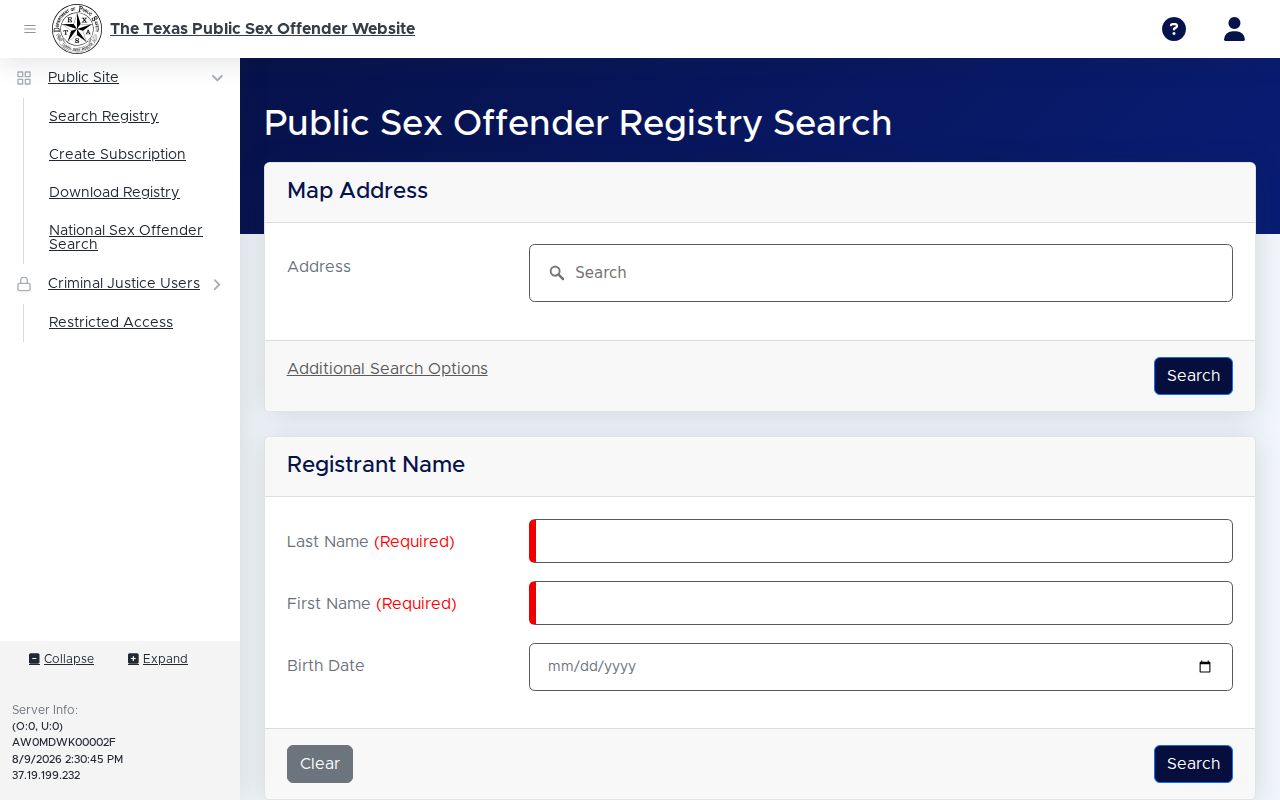
The image illustrates the state-run starting point for a Gregg County offender search while keeping identifying profile data out of the example.
Texas Public Sex Offender Registry Searches
The Texas Public Sex Offender Registry is free and designed for lawful public awareness. Before searching, decide whether the goal is to match a known person or review a place. Spelling and aliases can affect a name result. A county filter can find Gregg County entries, yet city boundaries near Harrison, Rusk, and Upshur Counties make a cross-border check useful when the location is close to a county line.
- Open the Texas DPS registry and read the terms and lawful-use warning.
- Choose Name, Address, ZIP Code, County, or School. Select Gregg in County mode.
- Review the list and map, including entries that may not geocode, and compare identifiers before assuming a match.
- Open the full profile to read the reported address, offense, status, and registration duration information in context.
| Search field | Type | Mode | Use notes |
|---|---|---|---|
| Last and first name | Text | Name | Spelling and aliases can affect results. |
| Address and city | Text | Address | Map distance is not a legal residency finding. |
| ZIP Code | Text | ZIP | Use a five-digit ZIP. |
| County | Menu | County | Select Gregg for the county view. |
| School | Text or location | School | Supports proximity and community-awareness searching. |
Gregg County Offender Registration Offices
Registration authority follows residence under Texas law. Municipal police chiefs handle city residents, while the Gregg County Sheriff handles residents of unincorporated areas. That means residents of Longview, Kilgore, or Gladewater will normally verify through the relevant city agency rather than a universal sheriff counter. County lines matter because all three cities extend beyond Gregg County.
For an unincorporated address, call the Gregg County Sheriff's Office at 903-236-8400 and ask for the current registration location and appointment process. The public source did not state a dedicated schedule or fee. Do not arrive at a jail counter and assume it handles registration. For a city address, contact that police department. Suspected noncompliance should also go to the responsible law-enforcement agency.
Gregg County Sheriff's Office
101 E. Methvin St.
Longview, TX 75601
903-236-8400
Call for the current unincorporated-area registration channel.
Note: Residence, not the county name in a broad search result, determines which local law-enforcement office performs registration work.
Registry Profiles: What They Show
A public registry profile combines identifying traits, the reported place information, offense data, and registration status. It should be read as a whole. DPS warns that an alphanumeric identifier alone does not establish identity; fingerprint comparison is the reliable identity link. A name or physical resemblance is not enough. The reported address is registration data, not permission to enter, visit, contact, or monitor the location.
| Name and aliases | Public identity names used to help distinguish records. |
|---|---|
| Photo and traits | Current photograph when available plus sex, race, age or birth data, height, weight, hair, eyes, and marks. |
| Reported address | The location reported for registration; map placement can be imperfect. |
| Offense details | Offense description or statute, conviction date, jurisdiction, and permitted victim category data. |
| Duration | Registration end information or a lifetime indication when shown. |
| Compliance status | The public status supplied through the registration system. |
The DPS source also withholds Social Security numbers, driver's-license numbers, phone numbers, online identifiers, employer contacts, victim identity, and protected juvenile material. Public access does not erase those privacy lines.
Gregg County Registry Profile Limits
The registry's neutral interface and detail layout show how many field groups can appear without making one screen a full life history.
The DPS registry profile source provides the official layout used for Gregg County registry records.
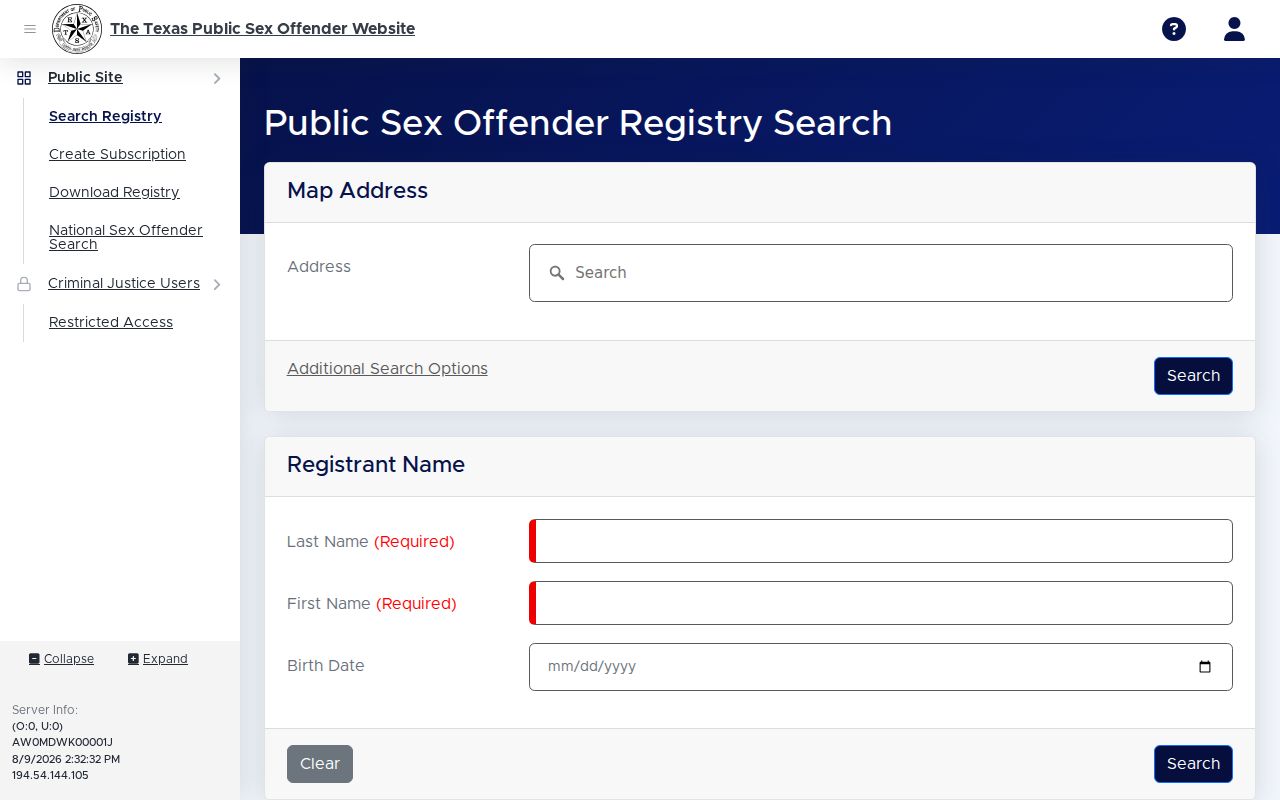
The image helps readers locate offense, address, physical-description, and status fields while avoiding publication of a private person's identity.
An address pin has limits. The redesigned registry includes an Unmapped category for records whose reported addresses did not geocode. A map-only scan can therefore miss a public entry. Proximity to a school or another point does not prove a residency violation. The governing offense, residence authority, court orders, and any valid local rule require legal review beyond the map.
Registration Levels and Duties in Texas
Texas does not reduce all registrations to a public Tier I, Tier II, and Tier III chart with fixed ten-year, twenty-five-year, and lifetime labels. Code of Criminal Procedure Chapter 62 ties duration and duties to the reportable conviction or adjudication and statutory category. Many offenses require lifetime registration. Other offenses use a post-discharge period that is often ten years. Juvenile cases and court risk determinations follow separate rules.
| Texas category | Duration pattern | How to read it |
|---|---|---|
| Lifetime category | Lifetime registration | Confirm the exact reportable offense and profile indication under Chapter 62. |
| Post-discharge category | Statutory period, often ten years | Count from the legally defined discharge point, not from a map search date. |
| Juvenile or court-determined case | Separate statutory and court rules | Do not assign an adult federal tier by appearance. |
Verification frequency also depends on the governing Texas provision and the person's registration facts. The research did not locate a Gregg County schedule that applies to all people. The responsible sheriff or city police agency should confirm the current duty.
Note: Do not convert a Texas registration profile into a federal tier label unless the governing law expressly supports that classification.
Gregg County Searches Across Borders
Longview reaches Harrison County, Kilgore reaches Rusk County, and Gladewater reaches Upshur County. A Gregg County filter alone can miss a nearby address just across a boundary. The National Sex Offender Public Website, maintained by the U.S. Department of Justice, searches participating jurisdiction registries and serves as the cross-state layer. It is especially useful when a name, trip, school, or address question extends outside Texas.
The official NSOPW landing interface shows the broader search source.
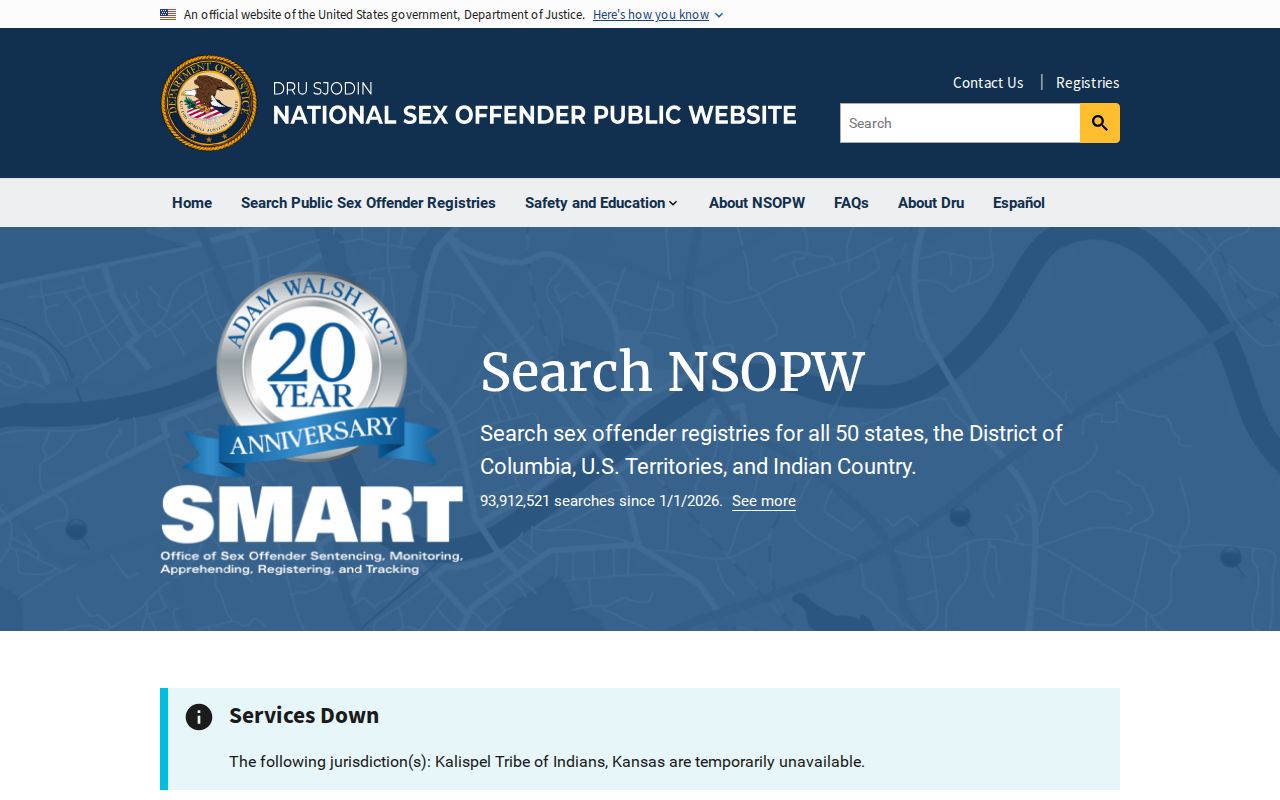
The national screen complements the Texas registry, but the originating state's profile remains the place to read its definitions and current registration data.
A cross-border result should be verified with the record's jurisdiction. Do not assume that Texas duration terms, public fields, or local registration practices apply to another state.
Report Gregg County Registry Concerns
Suspected noncompliance should be reported to law enforcement. For an unincorporated Gregg County address, call the sheriff at 903-236-8400. For an address within Longview, Kilgore, Gladewater, or White Oak, contact that city's police department. Provide the exact public profile, reported location, observed fact, and time. Do not investigate in person, trespass, follow anyone, or post claims that go beyond the registry.
An apparent mismatch can result from a recent update, an address that failed to geocode, a county-line issue, or a misunderstanding of the public field. The agency can compare nonpublic registration material and decide whether follow-up is warranted. Registry users cannot make that compliance decision from a map pin alone.
Save the official profile link and note when it was viewed. Clear, source-based details help the agency assess a Gregg County registry concern without guesswork.
Using Registry Information Lawfully
Gregg County registry information supports personal, family, neighborhood, and community awareness. It does not authorize confrontation or private punishment. Read the DPS disclaimer before each search and verify a concerning record with the responsible agency. Keep the source date in mind because addresses and compliance facts can change.
Misuse can be a crime: Texas DPS warns that registry information may not be used to injure, harass, or commit a crime against a registrant or household. Registration duties arise under Texas Code of Criminal Procedure Chapter 62, and unlawful conduct can bring penalties under applicable Texas law.
Do not visit a reported address. Do not treat a map point as a finding that a residence violates a distance rule. If immediate harm is threatened, contact emergency services. For a nonurgent compliance concern, use the local police or sheriff channel that has authority over the residence.
Note: A registry profile is public safety information, not an invitation to approach, shame, threaten, or monitor the listed person or household.